

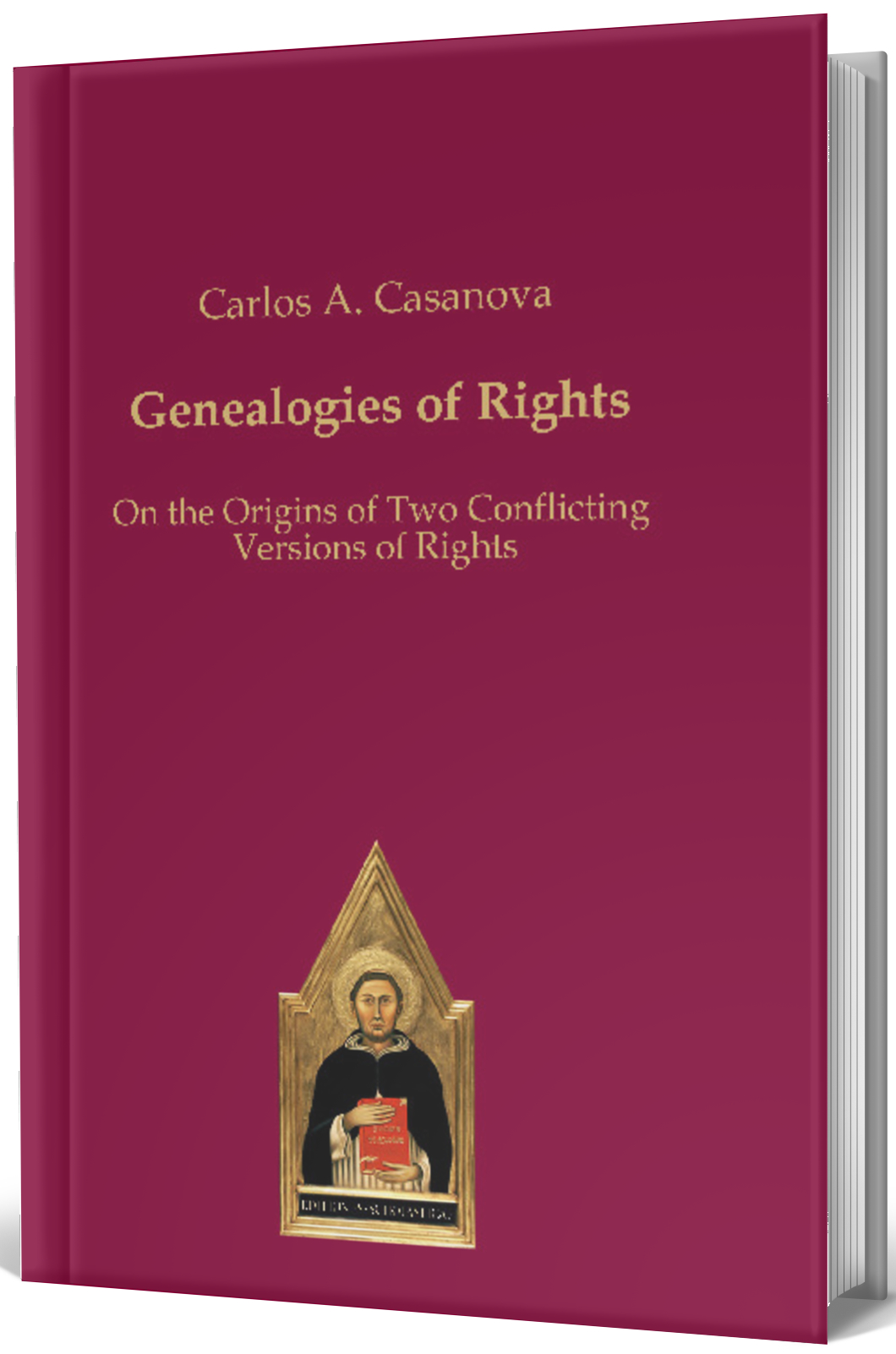
Carlos A. Casanova
Genealogies of Rights
On the Origins of Two Conflicting Versions of Rights
Abstract
Norberto Bobbio identified different versions of subjective rights. These pages contain a philosophical and historical investigation on the origin and the essential and distinctive traces of the classical-Christian and the liberal versions. Concretely, the book examines Michel Villey’s theses and Brian Tierny’s critique. It concludes that, although right was used in subjective sense before William of Ockham’s time, it was Ockham who, in his controversy with pope John XXII, for the first time used this term with a nominalist meaning. Against this version of subjective rights Francisco de Vitoria proposed an alternative in continuity with the classical tradition. The two versions have existed side by side since then and compete in providing its meaning to the political order of the West. The contrast between the 1789 Declaration of the Rights of Man and the Citizen, on the one hand, and the United States’ Constitution, on the other, exemplify this rivalry.
About the Author
Carlos A. Casanova is Venezuelan, former Director of the Graduate Studies in Philosophy at the Universidad Simón Bolivar (1999-2002). He had to leave his country in 2002 for political reasons. Senior Research Associate at the Maritain Center (2003-2005). Director of the Chilean Campus of the International Academy of Philosophy in the Principality of Liechtenstein (2010-2012). Professor of the School of Law of the Pontifical Catholic University of Chile (2012-2022). Faculty at the Hamilton Center, University of Florida (2023-today). Some of his main books are Practical Truth. In Defense of Classical Ethics (2023), Rationality and Justice (2013), Physics and Reality (2013), Man, the Horizon between Intelligible and Sensible Reality (2010), God, Being and Science According to Aristotle (2007). Translator into Spanish, and editor of the first bilingual edition of Aquinas‘ Commentary to the Book of Psalms (4 Volumes).